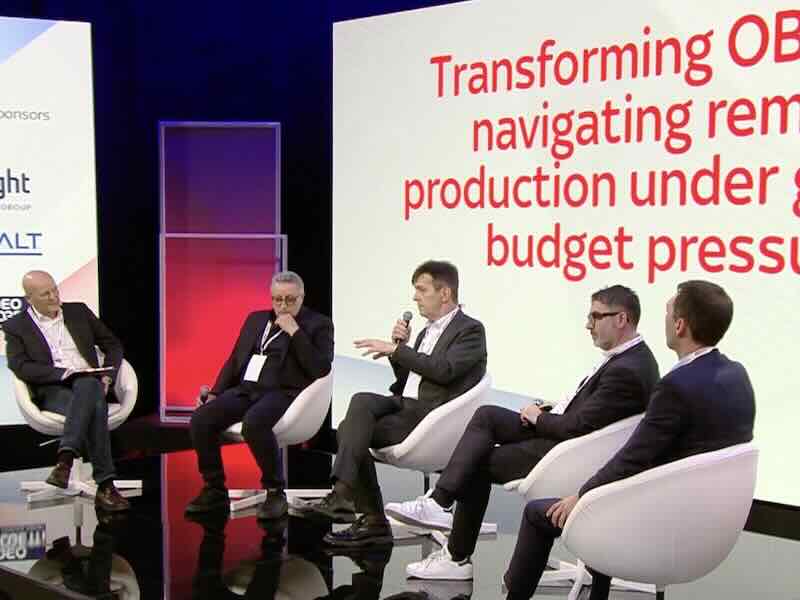
 Moderated by Luciano Consigli, Head of Production Engineering at Sky, this is a report of selected concepts presented during the workshop “Transforming OB: Navigating remote production under growing budget pressure”, held within Sky Italy’s annual summit in collaboration with SVG Europe.
The panel featured contributions from Francesco Donato of Gravity Media Italy, Ivan Pintabona of NVP, Fabio Ghezzi of Serie B, and Federico Bucci of Serie C.
Francesco Donato, CTO of Gravity Media.
He identified two crucial themes in the transformation of sport and outside broadcast operations: the migration to IP and the operational consequences of this transition.
The opportunity to work in remote production is linked to technological developments and to a broader economic framework.
Gravity Media, with offices in several countries, has for years conducted experiments in IP production with distributed teams and applications directly related to this technology.
The benefits observed concern flexibility and the ability to customise use cases according to specific applications, adapting them to each venue and operational context.
The challenge consists in implementing reliable and flexible solutions in the shortest possible time, taking economic constraints into account.
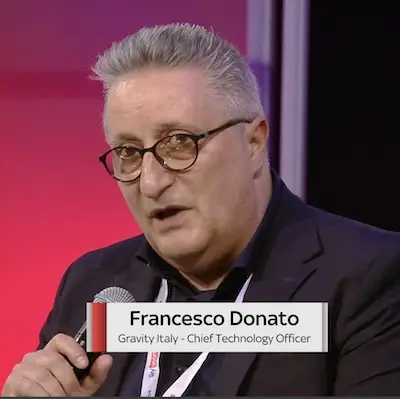 The approach is based on modular production blocks, and IP enables the architecture to be shaped according to operational requirements.
There is no single solution, and financial factors significantly influence systems that must remain efficient and operational.
OB operations can now be configured in traditional mode, but also in off-site configurations for remote production, as well as networked across multiple units with shared equipment when required.
Gravity also deploys container-based solutions suitable for heterogeneous operating conditions.
Alongside more complex solutions, lighter, scalable and multifunction architectures are implemented, capable of handling on-site camera capture while delegating production to a centralised remote control room.
This technology introduces improvements but also obligations, including the need for continuous staff training.
The workflow becomes easier to orchestrate, and the process entails a cultural shift that significantly affects organisational structures.
In the past, the central production role was the broadcast engineer, whereas today multi-level competencies are required and human resource management assumes a decisive role.
The company therefore invests significantly in internal training and in the professional development of external personnel.
Ivan Pintabona, CTO of NVP.
For NVP, raising quality levels without a significant increase in costs is central.
Strategic innovation is therefore a core element, and the new headquarters in Madrid represent the consolidation of expertise developed in Italy and through collaborations with Sky and partners such as Lega Pro Max.
Remote production and delocalisation processes make the availability of a proprietary platform essential, conceived as an investment capable of maximising the use of centralised technologies for both on-site and remote productions, even within the same day.
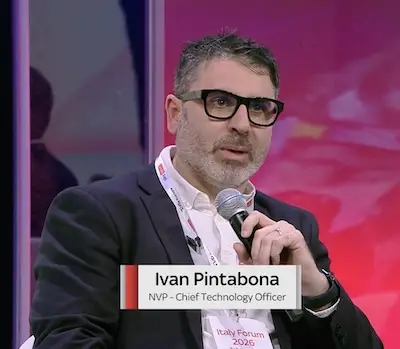 The operating model is hybrid and is based on multiple interconnected hubs.
One of the main hubs is located in Cologno Monzese, where experimentation began, supported by other nodes that enable resource ubiquity.
Initial trials conducted with Serie B, also aligned with Sky’s CO₂ reduction objectives, highlighted the importance of evolving the remote production model through new technologies without altering the underlying platform.
This approach requires systemic implementation and the abandonment of large hardware deployments dedicated to single events.
The current model is based on computational capacity.
The infrastructure allows software applications to be deployed precisely where required, and the workflow enables the selection of necessary functional blocks and the dynamic sharing of resources, with different operational configurations within the same day using the same computational capacity.
This development connects to the long-term objective of on-site automation, pursued progressively and pragmatically, achieving results comparable to those previously obtained with far more extensive operational deployments.
The current goal is to increase automated functions at the venue, particularly in camera management, now orchestrated and integrated within a trainable workflow.
The objective is not to reduce human presence, but to manage repetitive functions remotely according to automatable logics.
NVP is conducting research and development activities to enable the system to perform operations that are currently carried out predominantly on site, including video mixing.
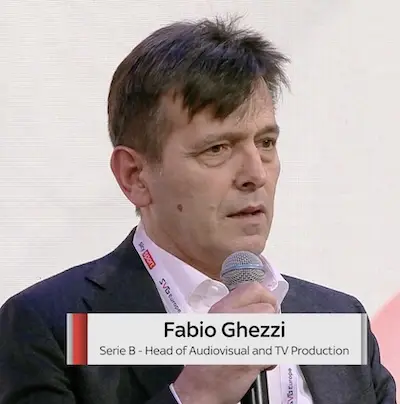 Fabio Ghezzi, Head of Audiovisual and TV Production of Serie B.
He identified the experience developed with Sky in remote production as decisive, highlighting human resistance to change as one of the principal critical factors.
Technology should not assume an ideological role but should follow operational directions capable of meeting concrete needs and generating measurable benefits.
The transition to IP is considered unavoidable but requires coherent integration within the adopting organisation through customised and progressively implemented procedures.
The current model is based on hybrid remote production configurations aimed at increasing production volume.
In perspective, automation supported by artificial intelligence systems represents the next stage of evolution, despite foreseeable organisational resistance.
Federico Bucci, Head of Media and Production and Consultant of Serie C.
He noted that the organisation adopted remote production from the outset, given the high number of matches, which made traditional production models impracticable.
The decision to produce and distribute the entire championship therefore made this model an operational necessity.
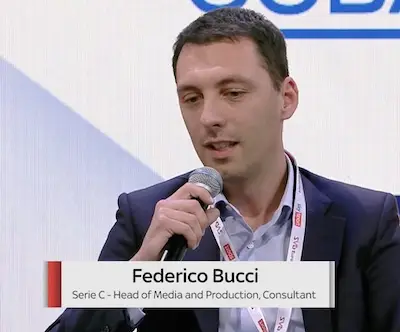 Broadcasting on Sky represents a significant recognition and at the same time a responsibility that has required substantial progress in production processes, graphics and the integration of statistical data, all within very limited budgets.
A shared strategy was therefore defined with the Clubs to ensure production and distribution sustainability.
Multiple modes of consumption have required new distribution strategies and agile, scalable production models, with the objective of delivering content where audiences are concentrated.
The challenge consists in distributing the maximum possible volume of content across the widest range of contexts and platforms, linking this distribution to monetisation models and brand compliance through tools designed to simplify operations.
###
Sinossi
Nel workshop “Transforming OB: Navigating remote production under growing budget pressure”, moderato da Luciano Consigli di Sky Italy con SVG Europe, il panel con Francesco Donato, Ivan Pintabona, Fabio Ghezzi e Federico Bucci ha analizzato la migrazione IP, i modelli ibridi di remote production e l’evoluzione verso piattaforme computazionali e automazione onsite.
Emergono architetture modulari IP centralizzabili, hub interconnessi, operazioni automatizzabili AI e workflow orchestrabili, con attenzione a sostenibilità economica, formazione continua e distribuzione multipiattaforma dei contenuti sportivi.
#RemoteProduction, #IPBroadcast, #OBProduction, #BroadcastEngineering, #MediaTechnology, #SportsProduction, #CloudProduction, #WorkflowAutomation, #ContentDistribution, #TVProduction
©2026 PressPool PressOffice RobertoLandini