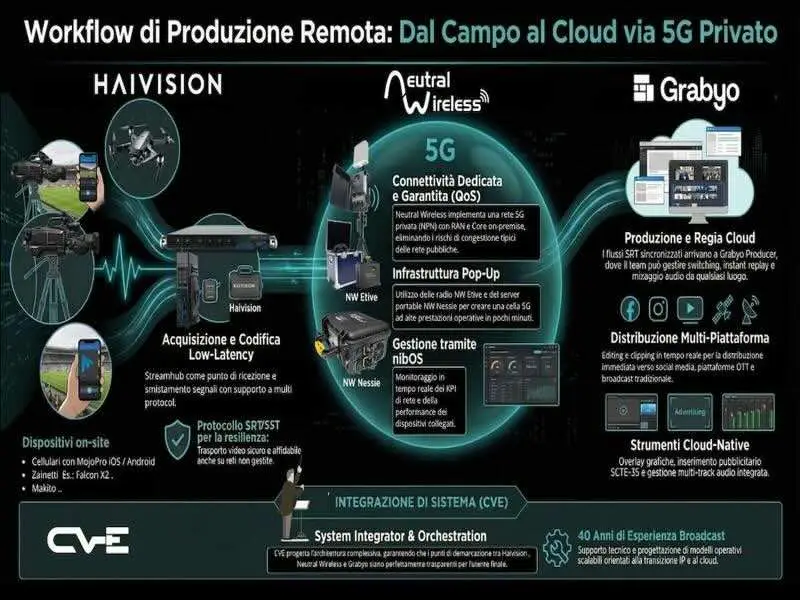
 On 19 March 2026, an open house took place at the headquarters of CVE - Communication Video Engineering in Verano Brianza, featuring operational demonstrations focused on live production and remote production over private 5G networks.
The event involved three key partners of CVE in Italy—Haivision, Neutral Wireless and Grabyo—and was aimed at professionals in broadcast, live events, sport, news and corporate communications.
In the opening session, Luca Catalano, CEO of CVE - Communication Video Engineering, outlined the central theme of the day, highlighting how private 5G has established itself as an enabling infrastructure for contemporary broadcast production.
The model has introduced operational flexibility, scalability and direct integration within IP and cloud workflows.
It has also demonstrated the overcoming of traditional RF technology limitations, with a transition towards distributed production models.
Neutral Wireless
Matt Stagg of Neutral Wireless opened the technical sessions by analysing the role of private 5G in broadcast production, describing an evolution of the operational model.
In an initial phase, the company utilised public 5G through network slicing for broadcast applications.
This approach was not adopted at scale due to technical and economic constraints.
Focus subsequently shifted towards private 5G networks, capable of ensuring isolated and dedicated IP connectivity.
Private networks enabled the deployment of independent infrastructures, usable by production teams and sports venues.
The primary operational advantage was identified in flexibility.
Compared to traditional RF systems, based on point-to-point links and per-camera costs, 5G enabled dynamic resource management.
Cameras were added or removed in real time, with non-linear cost scaling and increased scalability.
Infrastructure was deployed within short timeframes, including mobile configurations.
Neutral Wireless highlighted how the media sector presents specific requirements not always addressed by standard solutions from major vendors.
The transition towards IP and cloud workflows has positioned private 5G as an enabling layer, through integration with mobile production units and distributed infrastructures.
The company’s operational model included RF planning, spectrum acquisition, installation, commissioning, technical support and crew training.
Activities were also carried out through local partners.
In stadium environments, public network congestion was identified as a key issue.
Private 5G ensured full isolation from consumer traffic.
The architecture included coexistence between Wi-Fi for indoor areas, public networks for audiences and private 5G for critical services.
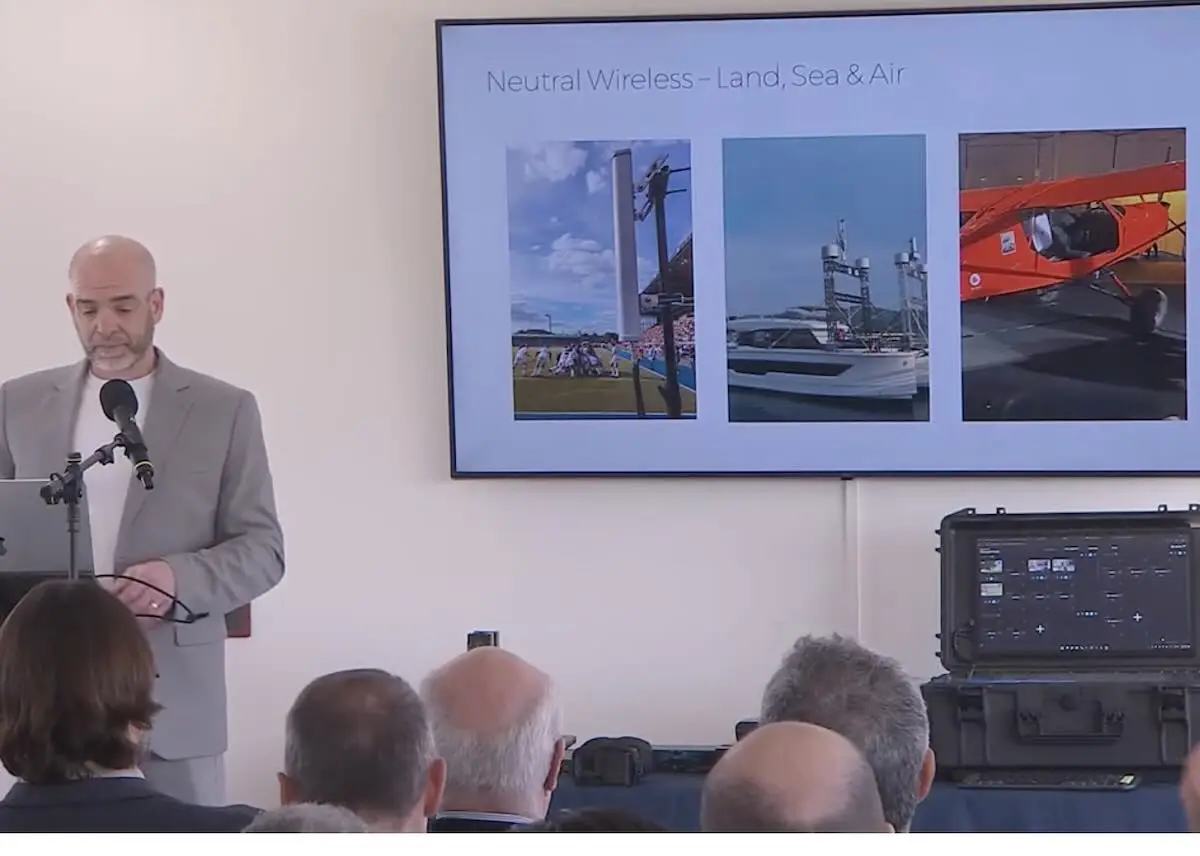
Traditional RF technologies showed limitations in mobility and scalability.
Private 5G enabled predictable uplink, the use of multiple cameras and integration of mobile devices, encoders and POV systems.
An increase in user-generated content via smartphones connected to private networks was also observed.
Use cases presented by Neutral Wireless focused on network infrastructures.
During the Paris 2024 Olympic Games, multi-site coverage was deployed, including installations on boats.
In the United Kingdom, during the coronation of King Charles III, a private network was implemented along the ceremonial route.
In sports production, solutions supported high-speed roaming feeds, ensuring stable connectivity even in the absence of adequate public coverage.
The offering included RF design, integration with IP devices and connectivity to satellite and cloud infrastructures.
Airborne solutions were also presented, with systems installed on light aircraft integrating core network, radio and antenna.
These platforms enabled dynamic event coverage and support for emergency scenarios.
 Haivision
 Haivision
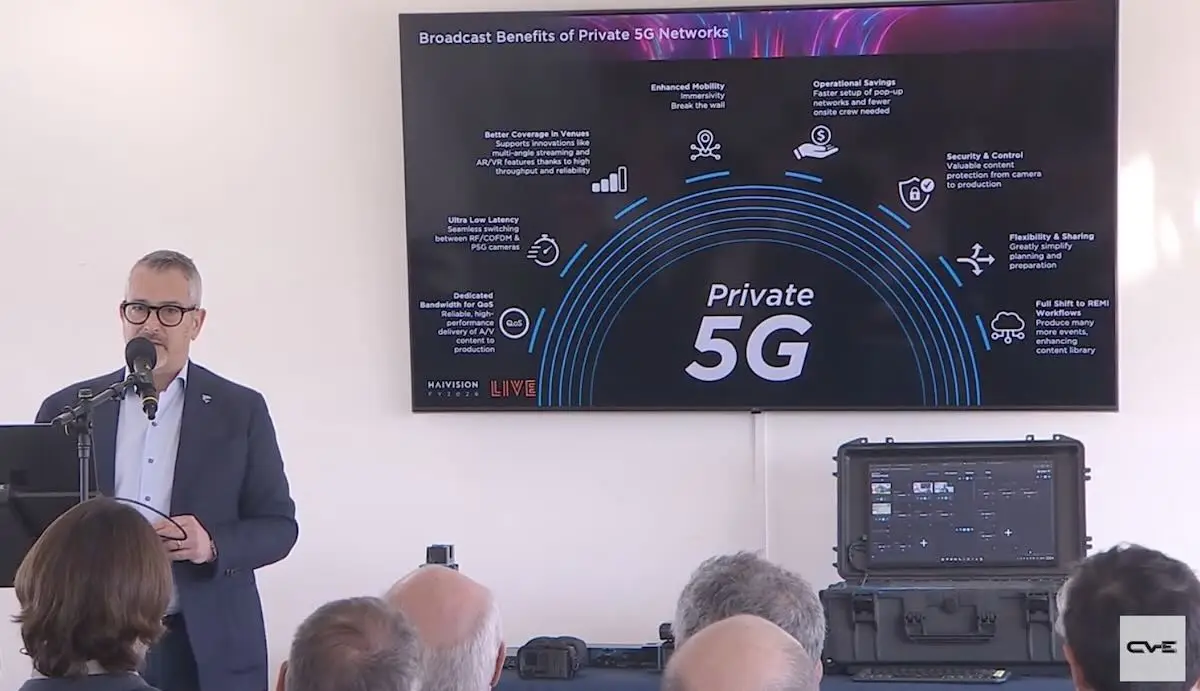
Fabio Veggiato of Haivision continued by analysing the use of private 5G as an alternative to public networks for video contribution.
Dedicated 5G “bubbles” were deployed both as a replacement for wired infrastructure and for traditional RF systems.
This architecture expanded capture possibilities, introducing greater mobility and new viewing angles.
Key benefits included the use of dedicated networks and ultra-low latency bonded transmitters, with performance comparable to RF cameras.
From an economic perspective, the model reduced production costs compared to traditional solutions.
Haivision presented a complete ecosystem for managing video flows, from contribution to distribution.
The StreamHub platform enabled signal management and conversion into major broadcast IP protocols.
The system integrated encoding, transmission and reception within a unified infrastructure.
Use cases illustrated by Haivision focused on video contribution over 5G networks.
During the Paris 2024 Olympic Games, in collaboration with Neutral Wireless, a system based on approximately 200 smartphones was used to capture video signals.
These feeds were sent to a centralised production hub for distribution.
In motorsport and football, implementations highlighted the use of private 5G to support new mobile production workflows.
Grabyo
 Grabyo
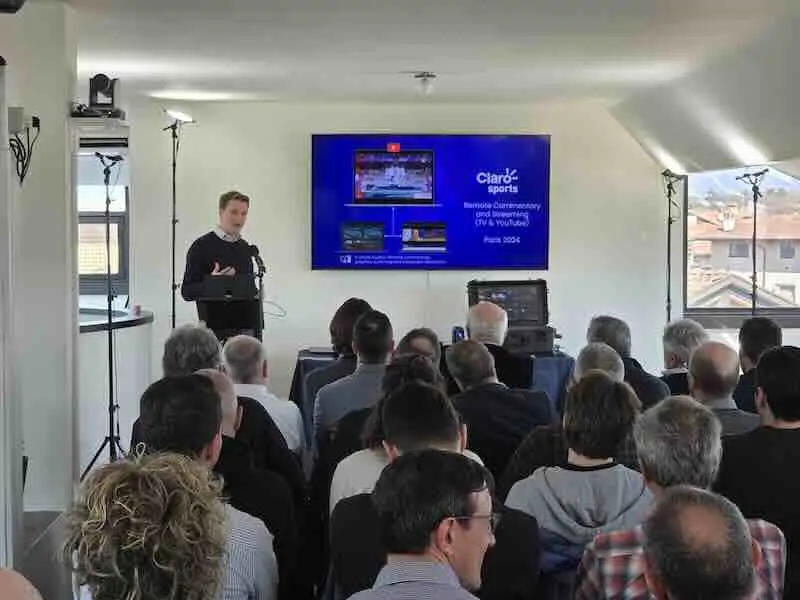
Charlie Prichard of Grabyo focused on cloud-based live production.
The Grabyo platform enabled multi-camera ingest and the creation of virtual control rooms activated in short timeframes.
The interface maintained alignment with broadcast workflows, also integrating hardware control surfaces.
The operational model was based on scalability and remote collaboration.
Productions were managed in distributed mode, without operational limits on the number of simultaneous events.
On-demand resource usage reduced costs across multiple live scenarios.
Grabyo presented use cases related to cloud production and distribution.
During the Paris 2024 Olympic Games, the platform was used for multi-event streaming and multiview services on connected TV.
In sport, it supported remote production and multi-platform distribution.
In tennis, the Wimbledon Championships adopted lightweight configurations for distributed editorial production.
The platform also supported live clipping and social media content production, enabling rapid generation of multiple formats.
Integration with cloud services introduced advanced automation and content management capabilities.
Overall, the open house outlined a three-layer ecosystem.
Neutral Wireless operated at the infrastructure level of private 5G.
Haivision managed video contribution and transport.
Grabyo enabled cloud-based production and distribution.
The integration of these layers defined a coherent operational model for live and remote production based on private 5G networks.
###
Sinossi
Open house CVE dedicato alla produzione live e remote su reti 5G private.
Haivision, Neutral Wireless e Grabyo hanno mostrato un modello integrato tra infrastruttura, contribuzione e produzione cloud.
Il 5G privato si conferma come base operativa per workflow IP distribuiti, con maggiore flessibilità, scalabilità e integrazione con ambienti cloud.
#broadcast, #5G, #remoteproduction, #liveproduction, #cloudproduction, #IPworkflow, #videotechnology, #sportsproduction, #mediainnovation, #digitalproduction
© 2026 CVE – Presspool PressOffice RobertoLandini
 INFO:
INFO: