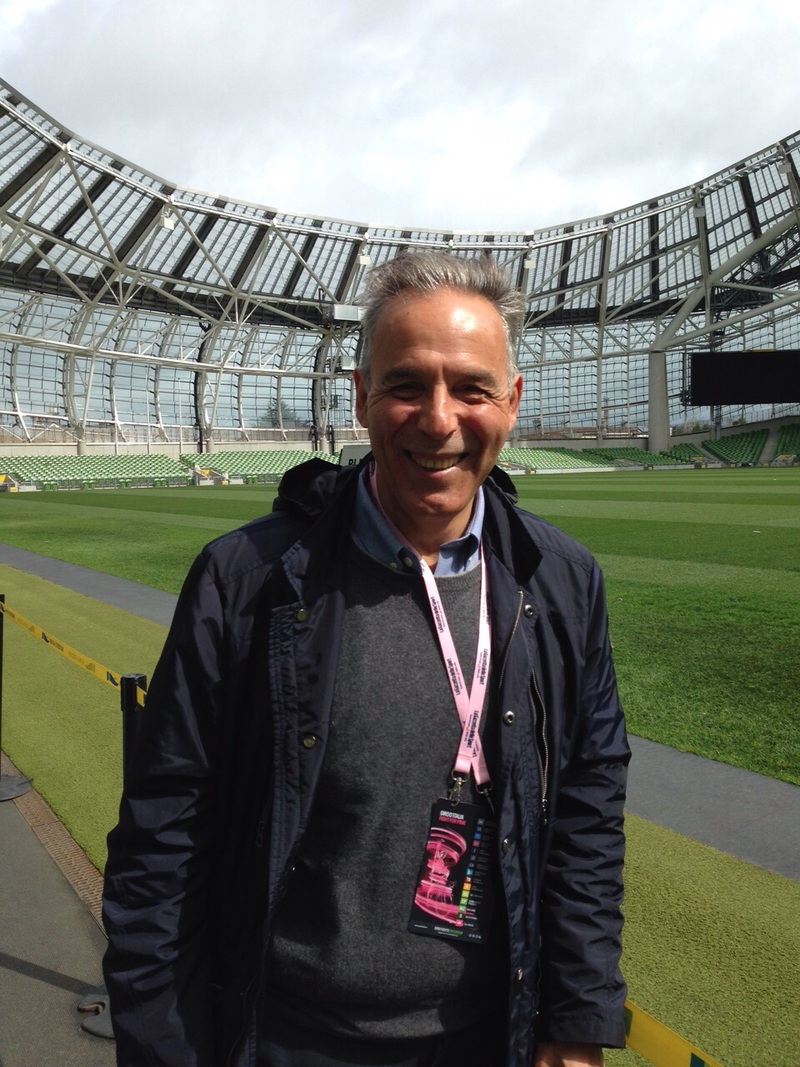
Virtualization and remote production, as at the Juventus Stadium (march 2016)
Popi Bonnici curriculum is impressive with 30 years of television, among the rest, ...Broacast & Media Consultant for Inter FC, Mastergroup Consultant for Mapei Stadium, Media and Broadcast Consultant for Juventus FC, All TV and Media matters Consultant regarding Project of Juventus Stadium, Library and Multimedia Archive Consultant for Juventus FC. And the current status of "Chief of Editorial Television Coverage" Lega Serie A 2015-2016 "leaves no doubt.
His Italian company, Tau Media, independently and among the many activities, studied the design and followed the implementation of the Juventus Stadium in Turin. Just starting from there we asked him to summarise his views on technology and television production today.
Bonnici says: "Today, in five years of operation, no upgrade was necessary at the Juventus stadium! Our project design had been managed with architects to harmonize the structural part. The result was the complete wiring in fiber and triax copper, to allow to shoot in SD, HD and even 4K. In fact, anywhere in the stadium there is the chance to leverage the existing wiring and remote production is based on the IP protocol, and fast Ethernet networks (electricity uncer ups, fiber audio systems or copper, fibre or triax videocameras, Lemo connectors, all on IP networks).
Surely, the the Juventus Stadium pattern repeats what will be the future of television, where the equipments are physically located in one place while their management is done by hundreds of meters and even thousands of kilometres away.
There are already many examples, such as the NBA, the Replay Center in Secaucus, N.J. All the images of the various playing fields come to the control centre and here the referees determine whether there has been an irregularity or not. Then they refer that image to the reqiusting stadium to certify or not the presence of an irregularity. Everything is managed through Ethernet networks.
Increase efficiency
This production scheme could be repeated also in other situations such as for example a television center dedicated only to replay.
Assume 10 replay machines used in three different times in the same day. Instead of binding up to 10 operators who must be physically present in the different venues, we can now collect them - and in a smaller number - in a single replay center; physical placed in a strategic way, in Milan, Rome, Turin or Bari and from there control easily the various equipments that are in different stadiums.
So it is multiplied the efficiency of any system.
Already today some "light" remote production tests have been made and one of these is for the Italian Lega Pro that installed two cameras on each field connected to a production centre via Ka-Sat systems. From here the director -easily- switches to taste the shots and makes up the story.
Physically only the cameras and operators are to be on the field, everything else, graphics, insets, replays can all be made in a remote production center.
It is no coincidence that a camera operator needs to be on field since his eye off the viewfinder can see much more than what the director sees on a monitor in the control room. The cameraman may suggest images sometimes in crucial situations.
So the main trend is not much to reduce the staff but improve the efficiency of a broadcast system; only the cameramen will always be essential on a playing field, the machines can be virtualised and positioned in a control room, where needed.
In other words, the technology will reduce the number of men in the field but can never replace them altogether. For everything else you can do a lot." Popi Bonnici, Tau Media.