Within the Internationa Basket Champions League, produced by Fiba.com, the team of Sassari, Dinamo Basketball, played against AS Monaco in the sports hall of Sassari, last March 22nd.
For events of this type, the service charge, Euroscena usually alternately employs two mobile vehicles, the obvan 20 HD and the obvan 22HD, named according to the number of cameras on board.
The choice of which unit to employ often depends on the viability and usually inspections are carried out before the event, given that it is often forced to operate in the historical centers or in any case where the road is not ideal.
The unit 22 is a long truck often used in football Champions League for the managed number of cameras; but in this case Unit 20 was chosen.
The cameras in the game, all by Grass Valley, were therefore a maximum of 20, but this time nine were positioned, placed according to specifications: the 1 and 2 were the "main cameras" and placed on the stands; the camera 1 took the game with a wider field, while the second taking care of shooting the game with a narrower frame that tends to favor details.
It was preferred to use shooting tripods rather than rolling towers, for an even greater stability in the images and general security.
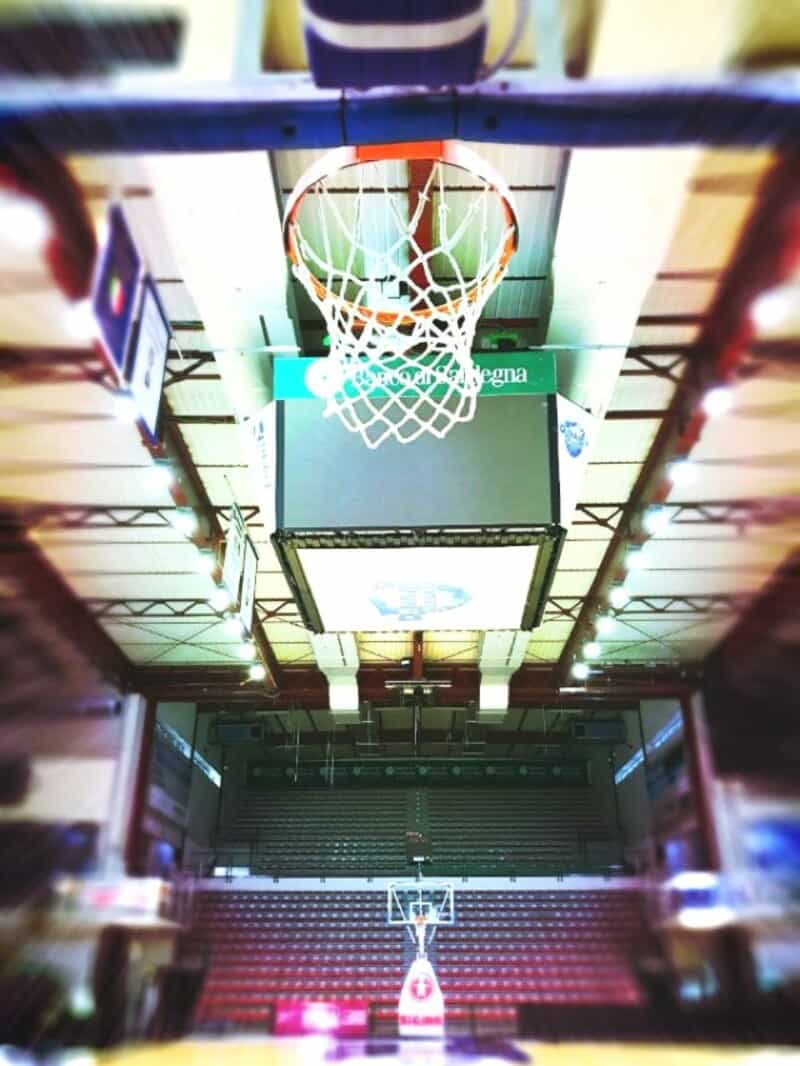
Then three mobile cameras were shoulder operated, one shot from mid court, and two other were placed just below the baskets.
Manuel Lombardini, technical manager of Euroscena tells us: "The shoulder cameras are much used in basketball to give more immediacy to the images but also because in many situations public come very close to the playing field itself and therefore space problems are frequent."
"However, the choice is always artistic and is always the director who prefers shoulder shots because the action in basketball is very fast."
"Any other camera on tripods could never be tilted fast enough to the basket, risking of losing important moments of the game. It's all in the immediacy, and the reaction speed is crucial."
Camera 6 is called "beauty" which returns images in the total field.
The 7 is a camera that frames the main board of seconds which in basketball is very important, as well as the score.
A local graphics timer takes care of this, but in case of a crash of camera 7 images become very important.
Other two cameras, Netcams, are installed just behind the boards, behind the baskets, remotely controlled, and are the same used in the back of the football goal.
All cameras generate video signals that are transported via triax apart from the latter two which signals travel via fiber up to the mobile gallery.
The main truck provides slow motion, and EVS server, 12 channels divided 8 in and 4 out, records all cameras in continuous mode and graphics are also recorded since Basketball FIBA Federation wants complete program copies and also the camera 1 feed with inserted graphics.
A single main feed -program- and backup with international signal is diffused.
An EVS machine, XFile, is network interfaced to the EVS, allowing to create transcodes of the data recordings to be output on USB sticks in H264 at the end of the match.
In basketball, in addition to USB sticks, after the game are also devered also some solid state hard disk memories with recordings of MXF files.
The basketball graphics are made locally by an English service.
###